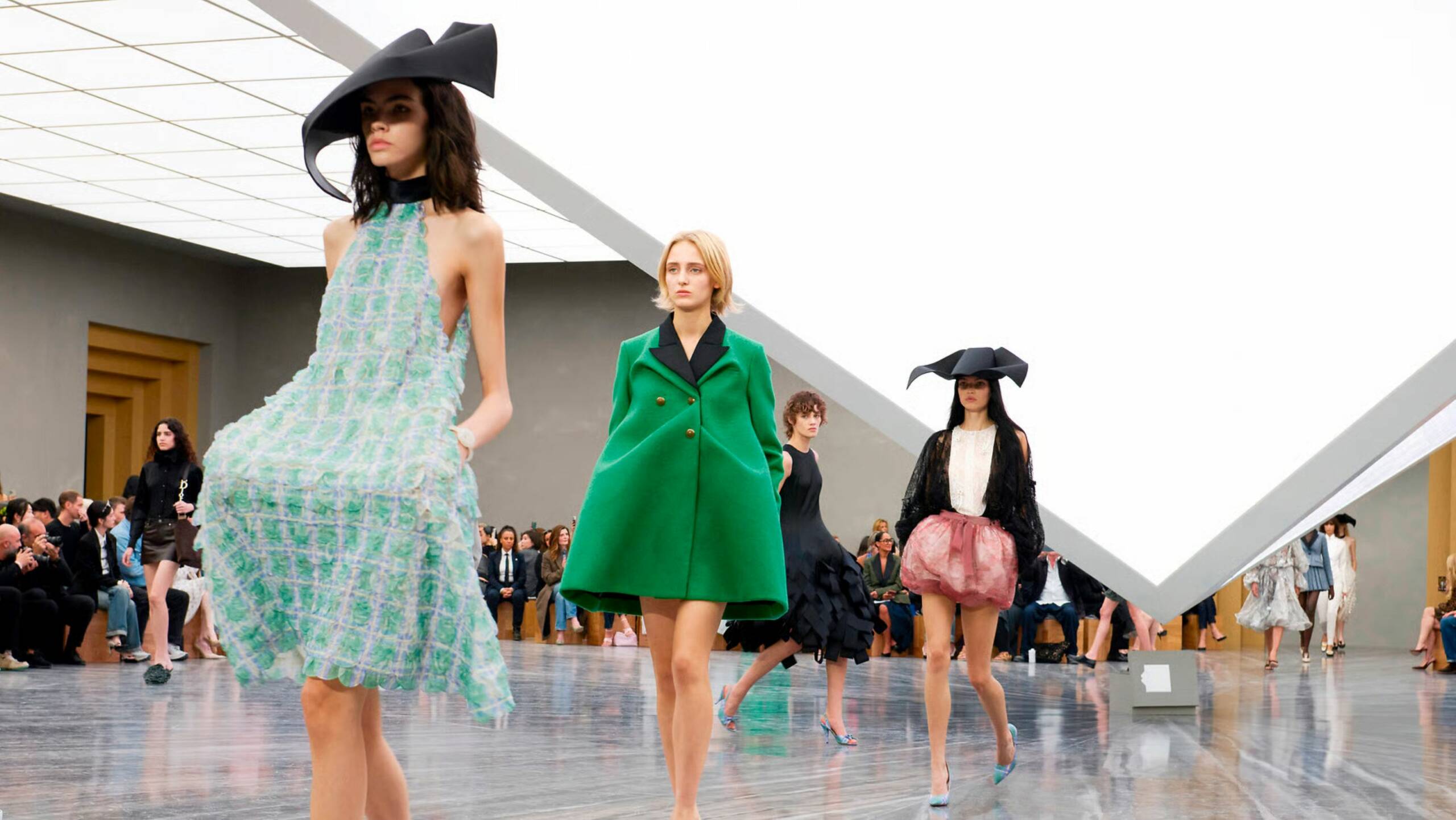
Generation Z consumes luxury goods differently, but do they still desire them? An exploration of an ambiguous relationship that is redefining the rules of desire.
She’s wearing a vintage Balenciaga T-shirt she bought on Vestiaire Collective, Uniqlo jeans, Adidas Sambas, and a woven leather Bottega Veneta bag she treated herself to with three months’ salary. She follows zero luxury brand accounts on Instagram but knows the history of Maison Margiela by heart. She refuses to buy new items out of environmental conviction, except when the product is “worth it.” She is 24 years old. And she represents the future of luxury—if luxury is willing to understand her.
The apparent paradox
For the past five years, the luxury industry has been observing Generation Z (born between 1997 and 2012) with a mix of fascination and concern. Studies have been published one after another, often contradicting one another. On the one hand, Bain & Company reports that Gen Z and Millennials will account for 75% of the luxury market by 2030. On the other hand, surveys reveal that this generation is the most distrustful of brands, the most sensitive to greenwashing, and the most resistant to conspicuous consumption
75%
Estimated share of Gen Z and Millennials in the luxury market by 2030 (Bain & Company)
How can we reconcile these two realities? How can a generation both reject excessive consumption and represent the primary driver of growth for the global luxury market? The answer is that this is only a paradox if we apply the frameworks of previous generations to Gen Z. Once we agree to view this generation through its own lens, the picture becomes clearer
The luxury of conviction, not of possessions
Gen Z doesn’t buy luxury goods to own them. They buy luxury goods to make a statement. The distinction is fundamental. For a baby boomer, buying a Hermès bag was an act of social advancement, tangible proof of success. For a Gen Zer, buying a luxury bag is an act of curation—the deliberate selection of an object that says something about their values, their aesthetic, and their knowledge.
This generation doesn’t collect brands. It collects individual pieces. It can wear a single luxury item amidst an outfit made entirely of affordable or secondhand brands, and that single item carries all the symbolic weight. Luxury is no longer a total lifestyle. It is an accent, a marker, a punctuation point in an identity drawn from multiple sources.
Gen Z doesn’t want to “be luxury.” They want to own an item that proves they understand what luxury really means. Knowledge is replacing ownership as a status symbol.
Expertise as a new form of social capital
One of the most striking trends of this generation is the depth of knowledge they’ve acquired about the luxury industry. Thanks to YouTube, TikTok, and specialized podcasts, a 20-year-old today can discuss the history of the Loewe brand, leather tanning techniques, and the differences between an ETA watch movement and an in-house caliber with a level of precision that would put some boutique salespeople to shame.
This democratization of knowledge is having a profound effect on the relationship with luxury. Gen Z is no longer satisfied with the surface—the logo, the image, the perceived prestige. They dig deeper. They want to know who designed the collection, where the materials come from, and how the price is justified. They distinguish true luxury—the kind rooted in craftsmanship, history, and technical excellence—from superficial luxury, which relies solely on marketing and the logo.
This requirement is good news for authentic homes. And very bad news for those that have built their appeal on image alone.
The secondhand market as a gateway
The luxury secondhand market is Gen Z’s natural habitat. Vestiaire Collective, The RealReal, and Vinted for more affordable items: these platforms have become the primary point of contact between young consumers and luxury brands. For many, their first luxury purchase isn’t made in a store but on a resale platform.
x2
The luxury pre-owned market is growing twice as fast as the new market (BCG, 2024)
For a long time, retailers viewed this phenomenon with suspicion, even hostility. The second-hand market was cannibalizing sales of new goods. It was eroding control over distribution. It allowed consumers to access products without going through the “in-store experience” so dear to retail executives.
But that interpretation was wrong. The secondhand market doesn’t cannibalize the luxury sector. It promotes it. The young consumer who buys a vintage Celine bag for 600 euros on Vestiaire Collective is not a lost customer. They are a customer in the making. They discover the quality of the leather, the precision of the cut, and the sturdiness of the construction. And when they can afford it, they will buy new because they will know, from firsthand experience, what justifies the price.
Reject the logo or reinvent it?
Much has been written about Gen Z’s rejection of logos. The reality is more nuanced. What this generation rejects is not the logo itself, but the logo as a substitute for substance. The Louis Vuitton monogram on an entry-level product designed to be “recognizable” is perceived as an intellectual scam. The same monogram on a travel trunk handmade in the workshops of Asnières is perceived as a symbol of legitimate craftsmanship
Gen Z makes a distinction that previous generations did not make—or at least not with the same rigor. It distinguishes between a logo used as a mere pretext and one that serves as a signature. The former is a price marker; the latter is a marker of value. And this distinction, however subtle it may be, has major strategic implications for brands.
Brands that have grasped this nuance are thriving. Bottega Veneta, which has built its reputation on a pattern (the intrecciato) rather than a logo, naturally resonates with this generation. The Row, whose clothing is recognizable by its cut rather than a logo, has become a cult favorite among the most discerning 25- to 35-year-olds. Even Hermès, despite having an iconic logo, is respected because the quality of its products justifies every penny of the asking price.
Gen Z didn’t kill the logo. It killed the empty logo—the kind that’s backed by nothing more than an advertising campaign and a high price tag. It’s a healthy purge.
Sustainability: Between Genuine Commitment and a Convenient Excuse
Gen Z’s commitment to the environment is genuine, well-documented, and non-negotiable. But it is also more complex than it seems. This generation demands transparency in supply chains. It punishes greenwashing with a severity that companies have never experienced before. It favors brands that take concrete action, and it has the tools to verify whether those commitments are being met.
However, this expectation goes hand in hand with a certain pragmatism. Gen Z doesn’t expect luxury brands to be perfect. They expect them to be honest. A brand that acknowledges the limitations of its supply chain and explains its efforts to improve them will be better received than one that claims to be “100% sustainable” without providing evidence.
Luxury has a structural advantage here. Its fundamental promise—products made to last, using the finest materials, in workshops that honor artisanal craftsmanship—is inherently compatible with the demand for sustainability. A Loro Piana coat worn for twenty years is, by definition, more sustainable than a fast-fashion puffer jacket thrown away after two winters. Luxury doesn’t need to reinvent itself to speak to Gen Z on this front. It needs to remind them of what it has always been.
What the Luxury Industry Should and Should Not Do
The temptation for luxury brands is to “speak Gen Z.” To ramp up collaborations with rappers, launch capsule collections with streetwear brands, and produce TikTok content with 19-year-old influencers. Some have done just that. The results have been, at best, fleeting. At worst, disastrous for the brand’s image.
What Gen Z expects from luxury isn’t that it adapt to them. It’s that it stays true to itself—and does so with authenticity, depth, and transparency. They don’t expect Hermès to join TikTok. They expect Hermès to keep making the best bags in the world—and to be able, one day, to see that for themselves.
The Gen Z / luxury paradox is only a paradox if we confuse luxury with ostentation. If we redefine luxury in terms of what it should be—excellence, sustainability, craftsmanship, and uniqueness—then Gen Z is not its enemy. It is its most demanding ally. And that is precisely what the luxury industry needed.