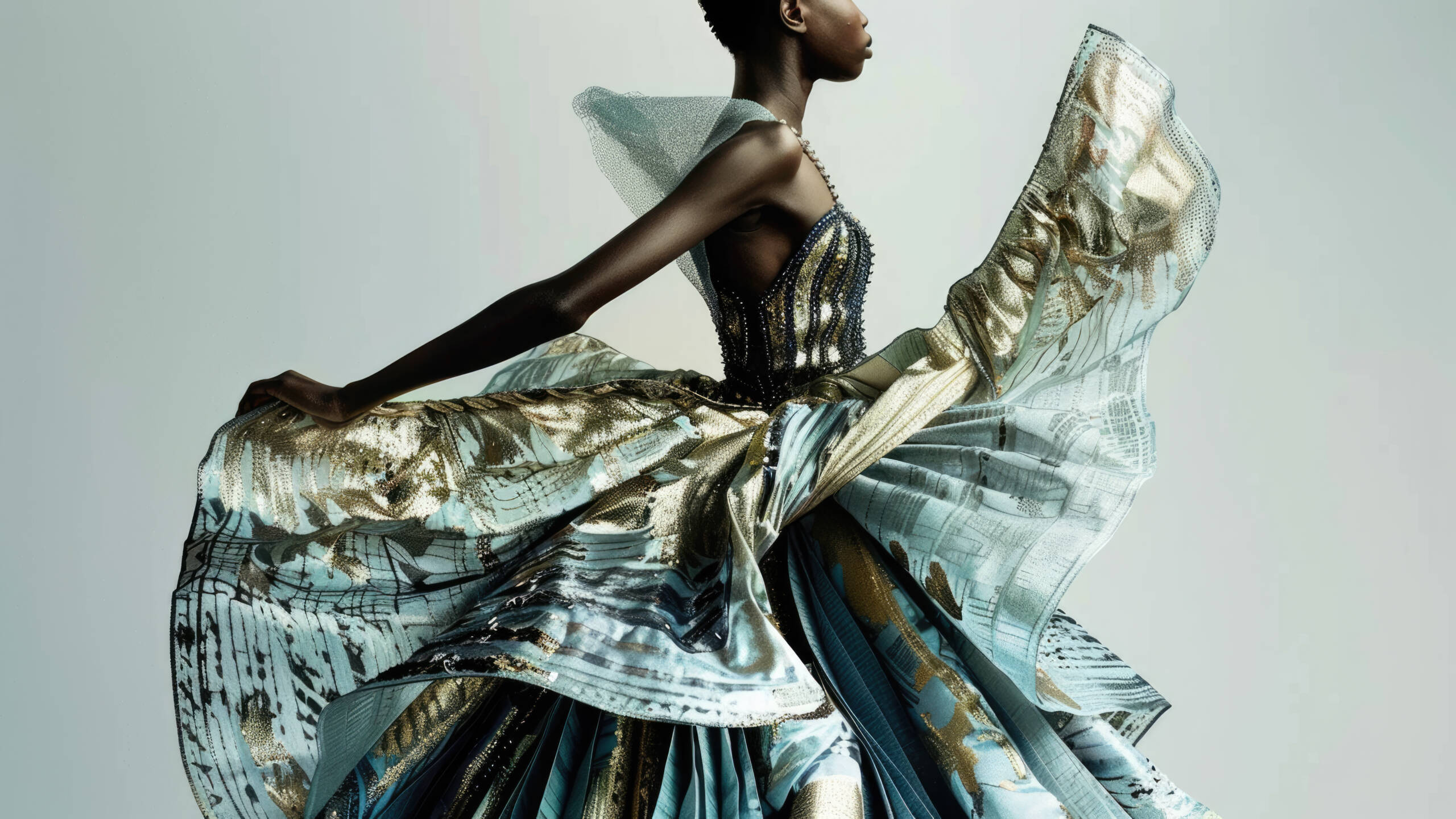
A Critical Analysis of the Impact of Midjourney, Sora, and Generative Tools on the Art Direction of Fashion Campaigns: Between Technological Fascination and the Dissolution of Uniqueness.
In less than two years, generative AI tools have revolutionized the creative production process. Photorealistic images generated in seconds, campaign videos created without a film set, virtual models indistinguishable from the real thing. The luxury industry, which has always based its value on the exceptional and the irreplaceable, now faces an existential question: what is the value of an aesthetic that anyone can produce?
The Alluring Promise of Creative AI
First, we must acknowledge the power of this tool. In its latest versions, Midjourney produces images of stunning quality. With just a few prompts, an art director can generate dozens of visual concepts for a campaign. Moods, settings, lighting—everything is possible, instantly, at a fraction of the cost of a traditional photo shoot.
For luxury brands, the temptation is real. Content production budgets have skyrocketed in recent years, driven by the insatiable demand of social media. AI promises to meet this demand without, on the surface, compromising visual quality. Some brands have already taken the plunge. Entire campaigns have been produced using generative tools, sometimes without the public even knowing it.
Sora, OpenAI’s video generation tool, takes this logic even further. Thirty-second fashion clips, with fluid camera movements, realistic textures, and lighting worthy of a seasoned cinematographer. All in just a few minutes. The question is no longer whether AI can produce luxury content. It can. The question is whether that content is still luxury.
The Paradox of Attainable Perfection
Luxury is based on a fundamental principle: scarcity. Scarcity of materials, scarcity of craftsmanship, scarcity of access. This scarcity breeds desirability. Generative AI, however, operates in exactly the opposite way. It democratizes access to an aesthetic that was previously the privilege of those who could afford the best photographers, the best art directors, and the best studios.
When a design student can generate, from their bedroom, an image that visually rivals a Hermès campaign, something breaks in the luxury equation. Not that the image is equivalent—it isn’t, for profound reasons we will explore—but it has the appearance of being so. And in a world dominated by screens, appearance is often all that matters.
AI does not threaten the luxury sector through mediocrity. It threatens it through its ability to simulate excellence, making the original indistinguishable from its copy in the eyes of most people.
Aesthetic homogenization: the real danger
The greatest risk posed by generative AI to the luxury industry is not visual counterfeiting. It is homogenization. AI models are trained on millions of existing images. They learn to produce what is statistically “beautiful”—that is, what most closely resembles what has already worked. The result is a consensus aesthetic: technically flawless, emotionally empty.
Take a look at the images generated by Midjourney in the “luxury mode” category. They all share the same aesthetic: soft, diffused lighting; neutral or slightly desaturated color palettes; graceful yet generic poses; and minimalist settings with a touch of opulence. It’s beautiful. It’s clean. It’s utterly forgettable.
Yet the most memorable fashion campaigns in history have been precisely those that defied convention. Guy Bourdin’s images for Charles Jourdan, unsettling and narrative. Juergen Teller’s campaigns for Céline under Phoebe Philo, raw and anti-glamour. Nick Knight’s visuals for Alexander McQueen, experimental and visionary. Each of these campaigns carried a signature, a vision, a rough edge that AI, by its very nature, is incapable of producing.
What AI Can't Do: Understanding Intent
A fashion image is more than just an image. It is an act of communication that conveys a specific intention. When Phoebe Philo chose 80-year-old Joan Didion to embody Céline, it wasn’t an aesthetic choice. It was a manifesto. When Demna dressed models in trash bags for Balenciaga, it wasn’t gratuitous provocation. It was a commentary on consumer society.
AI can replicate the form of these gestures. It can generate an image of an elderly woman in minimalist clothing. It can produce a high-fashion visual in an offbeat context. But it cannot convey the intention that gives these images their significance. It cannot decide that it is time to challenge beauty standards. It cannot feel the urgency to say something necessary
Artistic direction, in the noblest sense of the term, is not about producing beautiful images. It is the ability to give meaning to what is visible. And this ability remains, for now and perhaps forever, fundamentally human.
Homes Facing a Dilemma
Luxury brands are currently at a strategic crossroads. On the one hand, economic pressures are driving the adoption of AI: lower production costs, faster turnaround times, and the ability to produce content at scale to feed the social media machine. On the other hand, there is a growing awareness that giving in to this temptation could erode the very essence of the brand’s value.
The smartest approach is neither outright rejection nor blind acceptance. It lies in prioritization. AI can serve as an exploratory tool during the design phase: generating mood boards, testing creative directions, and accelerating ideation. It can be used for secondary content, social media visuals, campaign variations, and ephemeral content. But the images that define the brand’s identity—seasonal campaigns, runway visuals, and the images that will go down in history—must remain the product of a human vision, executed by human hands.
Luxury cannot be produced by an algorithm, because luxury is the opposite of optimization. It celebrates the passage of time, embraced imperfection, and gestures that seek beauty rather than efficiency.
Toward a New Definition of Authenticity
The emergence of generative AI in the luxury sector will, paradoxically, reinforce the value of authenticity. As AI-generated images become ubiquitous, the public will develop a new critical eye. They will learn to distinguish—perhaps not technically, but intuitively—between what is genuine and what is simulated. A photographer’s signature, the imperfection of natural lighting, the actual presence of a model in a real space—these elements will become markers of value.
Luxury has always been able to turn constraints into virtues. Handcrafted items are valued more highly than mass-produced ones precisely because they are slower to make, more expensive, and imperfect. In the same way, the “human-made” image will become a new criterion of luxury. A real photo shoot—with a photographer, a set, and live models—will become the equivalent of handcrafted work in the realm of imagery.
No, generative AI won’t kill the luxury aesthetic. But it will force it to redefine itself. To prove, through every image, every campaign, and every creative choice, that humans can still do what machines cannot: give meaning to beauty.
This article is part of the “Signal” section of Yvorine Magazine, which focuses on trends, innovations, and the future of luxury and fashion.